Clocked into Time
Horology Time Research Field Log
Timekeeping Archive & Illustrated Glossary
What time means to me?
What time means to me, Horology Time Research Field Log from a Students Viewpoint
Visual Documenting the Arts of Timekeeping, Illustrated Glossary Archive
With focus on learning through site specific studies, the psychogeography of the visual arts of timekeeping , the creation of a timepiece archive based on personal observational studies and an illustrated glossary of horology terms and accompanying study field log from a students viewpoint. Any creative input, pointers and scholarly input from expert horologists is sought out whenever and absolutely encouraged here too.
There is a dedicated feedback, advice and suggestion area accompanying this horology research study.
As I have a special interest in mechanical clocks, contemplation on time and its historical uses in everyday language I will begin there and see where the journey takes me.
Areas that fuel my curiosity are the typography and placement of public clocks within their contextual environments , the modern noticing or lack of sundial mottos and their meaning , the presence of sandclocks in historical art and mythology.
So this is an all round research project starting to look at history of timekeeping devices with a beginners curious mind. I wondered how does a clock movement actually work? When did we, humanity, start measuring time and how?
- and so this journey into the History of Timekeeping began
- Now I am Exploring : What does time mean to me ?
- Early beginnings of measuring time from sandtimers, water clocks to sundials
- Parts of a clock , how does the clock movement actually work in the most basic terms. How can I tell it is mechanical or, quartz or electrical
- Interesting historical clock design anatomy
HOW ?
Horology Time Research Field Log
Timekeeping Archive & Illustrated Glossary
- practice based hands on approach
- research led
- visual documentation
- creative response on site
- art studio developing
- sundial, mass dial and public clock archive building
Clocked Into Time - CIT
Clocked Into Time is an ongoing artist/illustrator led exploration of horology, the meaning of time,and curius timekeeping stories. There are so many interesting ways that people have communicated the passage of time And I am interested to see how this research study will progress through the various avenues of interest.
How did this research project begin?
Horology Time Research Field Log
The project began a little curiously. I stumbled upon a picture of an antique french mantle clock elaborately displaying golden figures embroiled in some kind of story around the center of a clock dial. It made me pause and ponder, I wonder why the meaning behind this clock design is ? And the journey through the history of timekeeping rabbit hole began just like that.
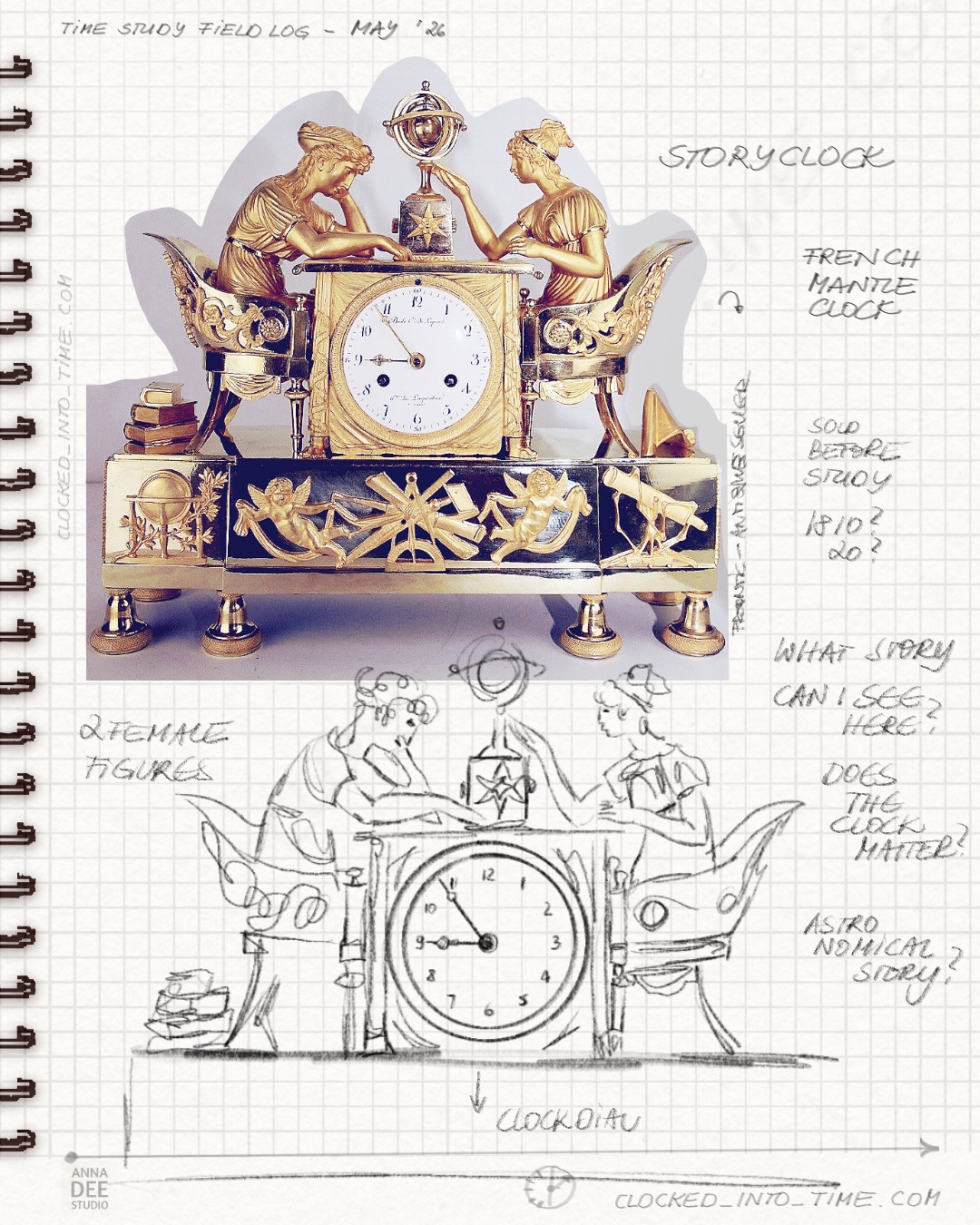

French Mantle Clock, circa 1818
I called it a mysterious story clock showing 2 women sitting on ornate chairs on a table which is surrounded by books, an astronomical glob, some further celestial symbols and of course a giant clock dial in the middle. Not knowing anything other than what the antique clock dealers description gave me, I learned it was called a mantle clock, the depictions it showed, materials it was made off and how old it would likely be.
But what initially sparked my curiosity was the stories that led to the design more than its technical horology specifications.
We are surrounded by clocks, watches, calendars, schedules, and digital displays, but I realised I knew little about the mechanisms of how a clock actually works, how to tell a mechanical timepiece from a modern version. And then it occurred to me I had never wondered how time had been recorded before these familiar devices became part of our everyday life. That curiosity sparked my interest both as an artist and researcher. I spent a few months wondering how to approach a more rigorous deliberate study of the subject of what time means to me, what are its myths, symbols, origins, stories hidden behind public clocks faces.
As the study developed, timekeeping revealed itself as a kind of meeting place for history, craftsmanship, science, architecture, landscape, ritual, language, mythology, symbolism, and all of the wonderful facets of human experience. A church clock is never only a clock. A sundial is never only an instrument. Even the simplest timekeeping object carries traces of the people who designed it, used it, maintained it, depended upon it, or built their lives around it. Often going entirely unnoticed in the busyness of today’s lives.
Rather than approaching the subject from a purely historian, horology, or academic side, I decided to frame it as a self directed art residency engaging the subject as a practice led artist researcher annd document the finding out from beginning through its natural progression, a Kind of psychogeography mixed with visual site specific responses.
The project is now driven by attention: visiting places, examining objects, intensive visual recording of field log observations, asking questions, following connections, and allowing understangding to develop gradually through sustained direct hands-on engagement.
The focus is not simply the measurement of time, but the many ways time becomes visible in the world. Sometimes this appears through clocks, watches, sundials, bells, calendars, and other instruments. Sometimes it appears through weathering, repetition, routine, seasonal change, architecture, folklore, literature, symbolism, or the traces left by generations of human activity.
Clocked Into Time combines fieldwork, visual research, site visits, drawing, photography, note-taking, archival investigation, and reflective practice. Together these form a long-term study that seeks to understand both the practical history of timekeeping and the wider cultural meanings attached to time.
The site serves as a public record of that journey and ‘in time and illustrated horology glossary and timekeeping archive for other researchers, enthusiasts and student to enjoy
Time is one of the few things every person experiences and no one can fully hold. This project is an attempt to pay closer attention to how humanity has sought to understand it.
Clocked into Time Research
Field Log & Timekeeping Archive
CIT - Clocked into Time
What time means to me, Clocked Into Time Research Field log,
 |
CIT
|
 |
CIT
|
CIT is a site about timekeeping, serving beginners, students, designers, artists, enthusiasts, and reflective history-minded readers who want both practical understanding and richer visual/context. They’re coming for clear foundations, reliable and well-documented examples, help finding real horology places and objects, and a more thoughtful, process-led way into the subject. Does that capture it, or would you adjust anything?
Exploring
- Sundials & Mass Dials
- Church Clocks & Chimes
- Public Clocks (Streets, Towers, Civic Time)
- Museums & Exhibits
- Mechanisms (Explained Accessibly)
- Greenwich, Meridian & Standard Time
- Time Imagery (Chronos, Father Time, Art & Sculpture)
- Favourite Timepieces (personal, curated)
History of Timekeeping & Components of Time Measuring Devices
Main Research Questions
- What did I study this month, how did I document it, and how is my understanding developing over time?
- How can this timekeeping object, place, mechanism, or observation be stored so I can find it again later?
- What is this timekeeping device or system, and how does it work in simple terms?
- What am I looking at, and what clues help me identify it?
- Why did people need to measure time, and where does this device or idea fit in that history?
- What does this clock, dial, site, or timekeeping object reveal when observed where it actually exists?
- How can timekeeping be interpreted through art, design, words, and reflection?
Time Research Objectives
Clocked into Time Research
Field Log & Timekeeping Archive
What can this clock, clock site, or timekeeping object reveal when observed in place?
Local clock walks, site visits, and site specific discoveries
Public clocks, industrial clocks. Church clocks, advertising clocks, railway clocks, sundials, mass dials, tower clocks, typography inscriptions, contextual surroundings, and overlooked clock design details
What changes when a clock is studied in situ rather than in isolation?
How do I record, organize, and retrieve my timekeeping research so it stays useful both for myself and fellow horology enthusiasts?
Building a searchable visual archive with naming systems, tags, metadata, and comparison structures, balancing personal documentation with scholarly usefulness lies at the core of this research project.
return to Clocked into Horology Time Research Field Log & Timekeeping Archive
New Field Log Entries
This Month
New timekeeping research additions have been made this month in the following field log entries
New Timekeeping Archive
This Month
- CIT Archive